Mocking Paul

Tune In’s take on Paul’s “Uncool” Musical Tastes

NOTE: The purpose of this analysis is not to exaggerate the severity of John’s onstage behavior which could have (at least occasionally) been conducted in good fun and camaraderie. The object is to determine whether or not Tune In is capable of presenting John’s disruptive and/or undermining behavior objectively in a way that allows the reader to judge the appropriateness of such behavior.

–//–

Multiple times throughout the book, Lewisohn writes with seeming approval about John undercutting Paul’s “soft” songs or musical tastes.

Here are five examples of this happening live, onstage:

On page 614, Lewisohn tells us how “Paul would flutter his eyelashes when he sang certain songs,” and calls Somewhere Over the Rainbow” one of [Paul’s] flutter numbers, guaranteed to go down a storm with the girls.”

Tune In describes John teasing Paul onstage: “John pointed to Paul, burst into raucous laughter and shouted, ‘God, he’s doing Judy Garland!’ Paul had to keep singing in the knowledge that John was pulling crips and Quasis behind his back or making strange sounds on his guitar to interrupt him.”

Of this, Lewisohn writes, “There were always several simultaneous reasons why an audience couldn’t take their eyes off the Beatles.”

About “Besame Mucho,” we get a quote from Lindy Ness: “When Paul sang ‘Besame Mucho,’ John used to stand behind him and make cripple faces. He had to: Paul was asking for it.” (p761).

During “A Taste of Honey,” John interrupts Paul’s performance by yelling at the audience. Lewisohn calls this behavior an example of “the Nerk Twins’ chemistry” (p1178).

When Paul sings “Till There Was You,” “[John] speaks most of the lines in a persistent piss-taking echo: ‘No, I never heard them at all’ (‘No, he never heard them’)” and Lewisohn writes, “[Paul’s] not even necessarily cross about it—he knows it’ll happen because this is John, and John is his fairground hero.” He also writes, “It’s part of the double-act, one among so many reasons they’re special together” (p1178).

Also about “Till There Was You”: “John really had a go at Paul for singing this—but didn’t try to stop him doing it, recognizing there was scope for all kinds of music in this group, to please all kinds of audiences” (p615).

Does it sound like John is preoccupied with projecting a “cool” image? We think so. Perhaps his undermining behavior garnered the praise and approval of a few (like Lindy Ness), but it could hardly be described as supportive of his partner (or reflective of good “leadership”).

And yet, Tune In always assures us that John is being awesome. Sometimes even a “hero.”

Instead of dispassionately framing John’s behavior as immature or insecure upstaging, Lewisohn calls John’s attention-seeking antics a part of John and Paul’s “chemistry,” which is “special and a “[reason] why an audience couldn’t take their eyes off the Beatles.”

And, of course, we hear once again that John is Paul’s “fairground hero.”

Somehow, by mocking Paul doing his “flutter numbers” John is “recognizing there’s scope for all kinds of music.”

Note that, according to Tune In, Paul himself isn’t recognizing scope by choosing and singing the songs (even in the face of mockery); John is recognizing scope by allowing him to do it (while simultaneously making fun of him for it).

Our final example is one where John doesn’t even allow Paul to finish his performance, and Tune In uses this to pay John the biggest compliment yet.

Regarding the Beatles’ live performance of Elvis’s hit single “Are You Lonesome Tonight”, only days after its release:

“Paul set down his guitar, clasped the microphone and did his Elvis act, the great solo star crooning his new slow one. It was already going to pot when he went into the long spoken-word middle section about ‘all the world’s a stage,’ which he’d crammed into his brain inside a few hours … and then John just stopped the group dead.

Refusing to be involved in anything so corny, John completely took the piss out of Paul, ripping his close mate and bandmate to shreds in front of everyone. ‘They sent me up rotten,’ Paul says, ‘especially John. They all but laughed me off the stage.’”

So from this description and Paul’s quote, we can surmise that the Beatles had rehearsed and prepared the number, “spoken-word middle section” and all. Why then, did John not object to the corny, spoken-word interlude during rehearsal? Assuming John’s mid-performance “piss-take” was not a comedy routine pre-planned by all the Beatles, this anecdote suggests that John knowingly set Paul up for public ridicule and relished the opportunity to pull the rug out from under him onstage.

To be clear, this would be a perfectly fine choice if Paul was in on the joke and consented to the bit. But deliberately setting Paul up to fail is unambiguously un-cool.

Nevertheless, here’s how Tune In justifies John’s behavior:

“This was the way John dealt with things, and he also knew the Beatles must have a solid front line, not back a soloist. As he said, ‘Every group had a lead singer in a pink jacket singing Cliff Richard-type songs. We were the only group that didn’t … and that was how we broke through, by being different” (586).

There’s no reason to connect John’s quote about “being different” to this anecdote (the footnote indicates his quote is taken from a December 1969 interview called “Pop Goes the Bulldog”) except to spin John’s behavior in the noblest way possible.

Paul wasn’t trying to be “a lead singer in a pink jacket”—he was merely taking the lead vocal just as John and George did in their turn. Did John also stop the band dead in the middle of his own solo spots, in order to ensure they kept a “solid front line” that would allow them to “[break] through by being different? Of course not. John is simply covering his embarrassment here, insecure about perceived softness, and seeking negative attention.

(For readers who may think we’re overblowing this topic, imagine for a moment if Paul was doing this to George Harrison onstage. Would Paul’s behavior be praised?)

It’s outrageous for Lewisohn to spin John’s every behavior into something awesome (“audiences couldn’t take their eyes off”; “fairground hero”), visionary (“we broke through by being different”), egalitarian (“solid front line”) broad-minded (“recognizing there was scope for all kinds of music”), and indicative of a GOOD PARTNER, actually (“part of the double-act”“Nerk Twins’ chemistry”“special together”).

Meanwhile, Paul is “asking for it” by doing “flutter numbers” “guaranteed to go down a storm with the girls,” “making his eyes big,” being “so corny,” and trying to be “the great solo star,” like a Cliff Richard knockoff “in a pink jacket.”

Does this portrayal look even-handed?

—//—

FULL EXCERPTS:

“[‘Are You Lonesome Tonight’] came out in Britain on Friday, January 13, and they did it the next night at Aintree Institute. Paul set down his guitar, clasped the microphone and did his Elvis act, the great solo star crooning his new slow one. It was already going to pot when he went into the long spoken-word middle section about ‘all the world’s a stage,’ which he’d crammed into his brain inside a few hours … and then John just stopped the group dead.

Refusing to be involved in anything so corny, he completely took the piss out of Paul, ripping his close mate and bandmate to shreds in front of everyone. ‘They sent me up rotten,’ Paul says, ‘especially John. They all but laughed me off the stage.’ This was the way John dealt with things, and he also knew the Beatles must have a solid front line, not back a soloist. As he said, ‘Every group had a lead singer in a pink jacket singing Cliff Richard-type songs. We were the only group that didn’t … and that was how we broke through, by being different’” (586).

—//—

“We always requested Paul to sing ‘Long Tall Sally.’ He used to say, ‘I can’t do it because it kills me throat,’ but then he would. He’d announce, ‘I’m doing this one for these two flossies over here,’ or something like that. Girls used to say his eyes were like mince pies. He had long eyelashes and would deliberately flutter them, and though you knew he was always aware of himself, he was so friendly to everybody that you couldn’t help but like him.’ 
—BERNADETTE FARRELL

One of the flutter numbers was ‘Over the Rainbow,’ guaranteed to go down a storm with the girls. The song from The Wizard of Oz seemed a strange choice, but the Beatles considered it valid because Gene Vincent did it. Paul sang it somewhere between the two versions, pausing impressively after the heightened ‘Somewhere’ and then sweetly rolling down. Cavern girls would get used to the sight: he made his eyes big, turned his face up and slightly at an angle and fixed his gaze above their heads on a brick at the far end of the center tunnel.

Sometimes John joined in with fine harmonies, but mostly he took the piss. Pete says that during one Cavern performance of ‘Over the Rainbow,’ John leaned back on the piano, pointed to Paul, burst into raucous laughter and shouted, ‘God, he’s doing Judy Garland!’ Paul had to keep singing in the knowledge that John was pulling crips and Quasis behind his back or making strange sounds on his guitar to interrupt him. Yet, if Paul stopped in the middle of the number, John would stare around the stage, the essence of innocence. There were always several simultaneous reasons why an audience couldn’t take their eyes off the Beatles.

Paul took such behavior from no one but John, but also he gave it back and was strong-minded enough to carry on doing what he wanted, knowing how much the audience liked it. He sang these songs well, and added one more to the portfolio at this time, the Broadway show number ‘Till There Was You,’ as covered in a new version by Peggy Lee—or Peggy Leg, as Paul called her. (He was given her record by his cousin Bett Robbins.) John really had a go at Paul for singing this—but didn’t try to stop him doing it, recognizing there was scope for all kinds of music in this group, to please all kinds of audiences … just so long as no one went near jazz” (614-15).

—//—

“LINDY NESS: ‘When Paul sang “Besame Mucho,” John used to stand behind him and make cripple faces. He had to: Paul was asking for it. But John wasn’t particular—he also took the piss out of George and Pete, mostly by imitations of some kind’” (761).

—//—

The tape throws great light on the Nerk Twins’ chemistry. While Paul is singing ‘A Taste of Honey,’ John suddenly shouts ‘SHUT UP TALKING!’ to someone in the audience, interrupting Paul much more than the chatterbox. Paul knows this, and is pitched into laughter. When he sings ‘Till There Was You,’ John—just a beat behind—speaks most of the lines in a persistent piss-taking echo: ‘No, I never heard them at all’ (‘No, he never heard them’). Paul chuckles and plows on; he can’t stop it, and he’s not even necessarily cross about it—he knows it’ll happen because this is John, and John is his fairground hero. It’s part of the double-act: the audience try to watch the singer but can’t tear their eyes off his mate, who’s probably also pulling crips. John couldn’t do this to anyone else without risking a thump, Paul wouldn’t accept it from anyone else; Paul gets to sing his song, John gets to undermine him. It’s just one facet of the complex sibling relationship they’ve always had, one among so many reasons they’re special together” (1178).

Fine Tuning: Ep 10 Unseen Paul


Listen HERE

SUMMARY: Unseen Paul builds on our earlier episodes by sharing even more quotes, stories, and insights about young Paul McCartney, who deserves a nuanced and dynamic portrait in any Beatles biography.

We explore some of his more overlooked character traits: his quirks and gifts; his stressors and anxieties; his unusual interests and values. These features reveal him as a fascinatingly dualistic artist and person.

SOURCES
Paul McCartney: the Definitive Biography by Chris Salewicz (1986)
The Beatles by Bob Spitz (2005)
“Portrait of Paul” Women Magazine by Mike McCartney (1965)
Magical Mystery Tours: My Time with the Beatles by Tony Bramwell (2006)
Many Years From Now by Barry Miles (1997)
Thank U Very Much by Mike McCartney
Paul McCartney on Howard Stern (2021)
“A Political Paul” Interview w/ Jonathan Powers for Prospect Magazine (Jan 17, 2009)
Paul McCartney interview w/ Hot Press magazine (2002)
Maureen Cleave “Intelligent Beatle”
“Mockers” Interview https://www.youtube.com/watch?v=j9e6zHA6eOY&t=116s
The Beatles Authorized Biography by Hunter Davies (1968)
The Beatles diary: Volume 1 by Barry Miles (2001)
BBC Interview “dyslexia” (October 4, 1997)
https://www.effinghamradio.com/2023/06/15/happy-birthday-paul-mccartney-2
Angie McCartney Interview w/ Geoffrey Guiliano (1984)
https://www.tumblr.com/pleasantlyinsincere/697307027602571264/angie-and-ruth-mccartney-on-saying-i-love-you-in?source=share
Mike McCartney; Beatles Book Monthly Magazine (1992)
Paul McCartney for New York Times Magazine (2020)
THE LYRICS by Paul McCartney and Paul Muldoon (2021)
Icke, Evelyn Hamann und die Beatles: Eine Art Biografie by Hans “Icke” Braun (2019)
A Cellar Full of Noise by Brian Epstein (1964)
Allan Williams quote from Music Legends The Beatles Special Edition by The Rock Review Music Legends Library (Sept 2, 2019)
https://issuu.com/codarecordsltd/docs/music_legends_beatles_special_edition
Interview w/ Horst Fascher for Deutschlandfunk Kultur (2006)
Astrid Kirchherr Interviewed by Colin Hall for Get Rhythm (August 2001)

PLAYLIST
Stairway to Paradise SARAH VAUGHAN
4 Pointers 1 TREVOR DUNCAN
Fine and Mellow ETTA JONES
Welcome to My World JIM REEVES
El Paso MARTY ROBBINS
You Go To My Head BILLIE HOLIDAY
Nature Boy NAT KING COLE
Black and White EARL ROBINSON
My Bucket’s Got a Hole in it HANK WILLIAMS
Spoonful HOWLIN WOLF
Since I Don’t Have You THE SKYLINERS
Perhaps DORIS DAY
Lonesome Town RICKY NELSON
Love to Love NINA SIMONE

Fine Tuning: Ep 9 WTF?


Listen HERE

SUMMARY:  In our 9th episode, we tackle a handful of loose ends from Tune In and pose the question: WTF?

Why The Farting?
Where’s Talented Friend?
Washboard To Fender
Weird, Those Fruits!
Women-Type Fans
Whores They F*cked?
Wow, That’s Fabricated!
Which Tune’s First?
Writing’s Too Fancy
Whose Teachers Finest?
Wimpy Teetotaler Frenemie


PLAYLIST:
Tutti Frutti LITTLE RICHARD
Good Golly Miss Molly LITTLE RICHARD
Where D’you Get Your Whiskey BOB CORT’S SKIFFLE GROUP
Mama, He Treats Your Daughter Mean RUTH BROWN
Mess Around RAY CHARLES
Spanish Flea HERB ALPERT
Theme from A Summer Place PERCY FAITH
Please Mr Postman THE SHIRELLES
School Days LOUIS JORDAN
Alligator Wine SCREAMIN’ JAY HAWKINS
I’ll Be On My Way THE BEATLES

May in Decemeber: AKOM Talks w/ May Pang Pt 2


Listen HERE

SYNOPSIS:  In her second appearance on AKOM, May Pang talks with Phoebe about Yoko enlisting Paul’s help during the Lost Weekend, John & Yoko’s Tittenhurst Safe Room, The (not) Malibu Dream House and Primal Scream Therapy.

The Lost Weekend: A Love Story is currently available for purchase or streaming on most major platforms. Discover more at www.maypang.com

Fine Tuning: Ep 8 No Greater Buddy

Listen HERE

SYNOPSIS: No Greater Buddy examines how Tune In handles the naughty behavior of its resident Bad Boy, John Lennon. This is a study of Lewisohn’s coverage of John’s bad behavior (rather than the behavior itself).


PLAYLIST
Bad Boy LARRY WILLIAMS
Let the Good Times Roll LOUIS JORDAN
Jim Dandy LAVERN BAKER
Handful of Keys FATS WALLER
Undecided ELLA FITZGERALD
Angel Baby ROSIE & THE ORIGINALS
Night Train DAVID ROSE
Devil or Angel THE CLOVERS
I’ll Be on My Way THE BEATLES

SOURCES
The Beatles by Hunter Davies (1968)
The Other Side of John Lennon By Sandra Shevey (1990)
Beatles Anthology (1995)
Living in the Material World by Martin Scorcese (2011)

Fine Tuning: Ep 7 Spanner in the Works

Listen HERE

SYNOPSIS: Spanner in the Works shows how Paul is portrayed as uniquely difficult to manage and unjustifiably obstructive, even to the point of sabotaging the band. 

We use Tune In’s reporting of the early friction between Paul and Brian Epstein as a case study to illustrate how Tune In guides the reader to distrust and second-guess McCartney whenever he comes into conflict with other major players in the Beatles’ story.

PLAYLIST
Maybe THE CHANTELS
Oop Shoop SHIRLEY GUNTER & THE QUEENS
Tequila THE CHAMPS
I’m Walkin FATS DOMINO
Lucille THE BEATLES
Devil in His Heart THE DONAYS
Baby It’s You THE SHIRELLES
Slippin and Slidin LITTLE RICHARD
Too Much ELVIS PRESLEY
Fast Freight RITCHIE VALENS
I’ll Be On My Way THE BEATLES

SOURCES
“Portrait of Paul” Mike McCartney Woman Magazine, 1965
McCartney the Definitive Biography by Chris Salewicz, 1986
John Lennon Interview w/ Jann Wenner for Rolling Stone, May 14, 1970
John Lennon Interview w/ Lisa Robinson for Hit Parader, 1975
John Lennon and Yoko Ono Interview at St Regis Hotel by Peter McCabe and Robert Schonfeld, September 5th, 1971
Lennon Remembers by Jann Wenner for Rolling Stone, 1971
In My Life by Pete Shotten, 1983
Interview w/ Pete Best in Music Legends The Beatles Special Edition by The Rock Review Music Legends Library Sept 2, 2019

Fine Tuning: Ep 6 A Prolonged Jealousy

Listen HERE

SYNOPSIS: In A Prolonged Jealousy, we tackle one of Tune In’s main talking points: that Paul McCartney is a fundamentally jealous person whose obsessive, one-sided jealousy of and over John Lennon was brought to a boil by the presence of Stuart Sutcliffe in the band. 

Is Tune In’s unforgiving portrayal of Paul’s jealousy fair? Or is it over the top? We’ll discuss!

UPDATE 11/21/23:

A relevant piece of info that we did not include in our original airing of this episode (4 days ago) has just come to our attention.We apologize for the initial oversight. 

This episode was originally posted on Nov 17, 2023 and then re-uploaded on Nov 21, 2023 to add a few minutes of additional information relevant to the topic. We haven’t edited or deleted anything from our original conversation, just added the additional info to the discussion midway through the episode (for exact timestamp, see episode notes on streaming platform).

PLAYLIST
Frenzy SCREAMIN’ JAY HAWKINS
Woo-Hoo ROCK*A*TEENS
Raunchy BILL JUSTICE
What’d I Say RAY CHARLES
Lucille LITTLE RICHARD
Flamenco Sketches MILES DAVIS
Sleepwalk SANTO AND JOHNNY
Let it Be Me THE EVERLY BROTHERS
Just Walking in the Rain THE PRISONAIRES
Go! Go! Go! ROY ORBISON
Duck Tail JOE CLAY
I’ll Be On My Way THE BEATLES

SOURCES
The Beatles by Hunter Davies (1968)
The Beatles by Bob Spitz (2005)
“The Beatles’ Shadow: Stuart Sutcliffe” by Pauline Sutcliffe (2002)
“The Lost Beatle: The Stuart Sutcliffe Story” BBC (2005)
Paul McCartney The Life by Philip Norman (2016)
Beatles Book Monthly Magazine (May 1994)
Beatles Anthology (1995)

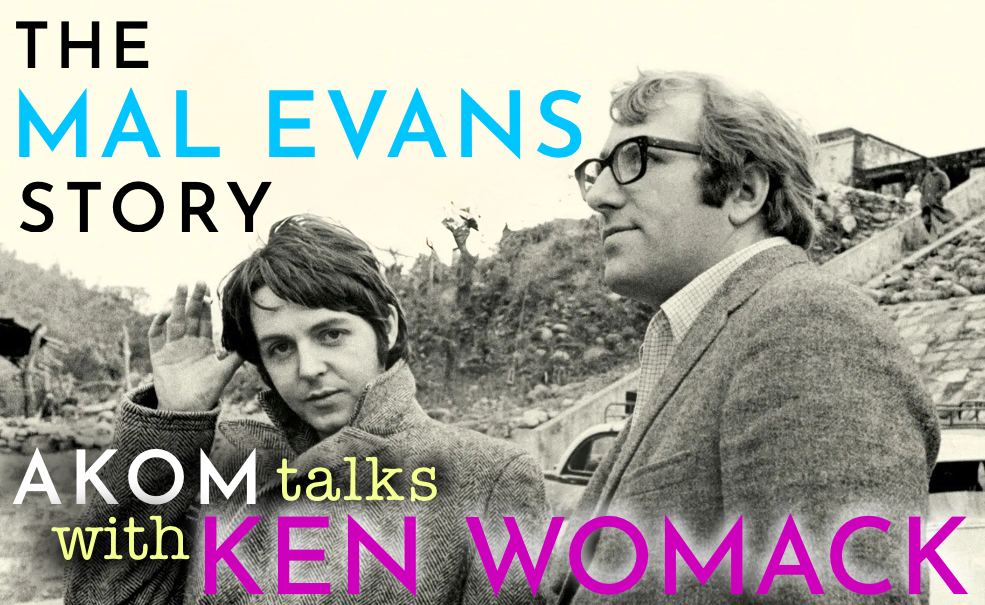
The Mal Evans Story: AKOM Talks w/ Ken Womack

Listen HERE

SYNOPSIS: Phoebe Lorde and Allison Bumsted talk with Kenneth Womack about “LIVING THE BEATLES LEGEND: the Mal Evans Story.”

We discuss several of the amazing topics raised in this wonderful book; Elvis, cowboys, Allen Klein being horrible, the tougher-to-write moments in the book, interpersonal relationships within the Beatles’ circle, and of course the fascinating life of the incomparable Mal Evans.

Leader Lennon: Quotes Lewisohn Chose

“Michael Hill, who like John came to Quarry Bank from Dovedale Road, says that though John and Pete were close, John was definitely the leader. ‘It was always “Lennon and Shotton,” never “Shotton and Lennon.” Pete wasn’t without talent of his own but he was an acolyte of John’s. We all were.’”

Page 96
Author interview, June 1, 2005 (footnote 47, p1199)


“Colin Hanton, the drummer…was 18, and joined through Eric Griffiths, but knew to whom he must answer. 

‘John didn’t say “I am the leader,” he just led, and we just followed him,’ he recalls. “There was never any discussion and it was never a problem. We just assumed John was the leader. He was the singer and whatever he wanted to sing we played.’”

Page 160-1
Interview by Spencer Leigh (footnote 42 on p1209)


“Pete Best watched the three lads who, with Ken, were looking around the cellar of his house. He noticed how the arty one, John, looked and acted the leader from the start,’ and how he alone decided where they would play ‘while Paul and George hovered in the background silently agreeing.’”

Page 341 
Beatle! (footnote 11 on p1240)


“Though John was indebted to Tony [Carricker] for broadening his musical horizons, Tony gained most from the friendship. 

‘I was an acolyte of John’s, it was an acolytish relationship, because he had the personality. He was very much a force of nature—he was frightened of far fewer things than most people, he had no social fears, wasn’t constrained by all the silly little things in life and had tremendous self-confidence and good fun. He was a very, very good mate.’

All the friendships in John’s life were like this: he was the leader, respected and gratefully followed by others. But perhaps for the first time here at college there was an exception: John found a friend he revered.

Page 258 
Carricker’s quote from: Author interview, 2004 (footnote 41 on p1227)


“Cyn observed how [Paul] ‘tried hard to impress John, posing and strutting with his hair slicked back to prove that he was cool, because John was very much the leader.’”

Page 350
John (footnote 26 on p1241)


“A Wirral newspaper reporter spoke to them on their opening night at Neston Institute on,Thursday, June 2—the Beatles’ first headlining and advertised performance anywhere—and the resulting article had it right: they were the Beatles with an ‘A.’ As for their individual names, though, the Scotland legacy was (mostly) lingering on: ‘John Lennon, the leader, plays one of the three rhythm guitars, the other guitarists being Paul Ramon and Carl Harrison. Stuart Da Stael [sic] plays the bass, and the drummer is Thomas Moore.’”

Page 479
Birkenhead News and Advertiser (Heswall & Neston edition),
June 11, 1960 (footnote 6 on p1259)


Pat Moran:

“‘John was the leader. He used to talk to Paul and then they’d play something, but Paul was also the leader in a way because he was very much part of it. Certainly it was between Paul and John as to who took the lead. Paul was my favorite. I can still picture him at the front with his guitar, left-handed. He was on the left side of the stage, then George alongside him, then John, and Stuart on the right.’”

Page 493-4
Author interview, July 17, 2006 (footnote 30 on page 1261)


“[W]riter, Derek Runciman, liked the Beatles and what they had to say, and it was here (in the November 1 issue [of Dance News]) that they were first quoted in a national publication. John was identified in print as ‘leader and founder of the group’ (which they’d agreed to say, if anyone asked) and this time, on his 22nd birthday, he did all the talking.”

Page 1078


“June Harris was another writer to scent originality.

‘The Beatles were new to London and hadn’t really acquired any sophistication or expertise yet, but they certainly struck me as having more substance, more purpose, than a lot of people I’d interviewed. George was very sweet and kind, a nice young man, Ringo didn’t say much, Paul was sensible and taking things in his stride, and John just got on with it, like “I know where I’m going and what I want to do with this group.” The others were deferential to him—he was the leader and had a sense of direction for all of them, and when he had something to say he said it, and why not? He wasn’t going to take shit from anyone.’”

Page 1128 
Author interview, April 6, 2004 (footnote 4 on page 1359)

Fine Tuning Ep 5: Leader Lennon

Listen HERE

SUMMARY: Leader Lennon examines Tune In’s major thesis, that John Lennon was and is the leader and implicit owner of The Beatles forever. 

We take a hard look at Tune In’s obvious affection for hierarchy and dominance and how this pervades its storytelling. We’ll discuss the deficiencies of this framework, why it is a problem, and how it distorts the Beatles’ story.

PLAYLIST
Tiger Man RUFUS THOMAS
Lovin’ Machine WYNONIE HARRIS
Honey Don’t CARL PERKINS
Besame Mucho TRIO LOS PANCHOS
Crying, Waiting, Hoping BUDDY HOLLY
C’mon Everybody EDDIE COCHRAN
Soldier of Love THE BEATLES
Rip it Up ELVIS PRESLEY
I’ll Be On My Way THE BEATLES

SOURCES
The Beatles by Hunter Davies (1968)
Pre-Fab by Colin Hanton (2018)
The Beatles by Bob Spitz (2005)
John by Cynthia Lennon (2005)
Alan Williams from Stuart Sutcliffe: The Lost Beatle, BBC (2005)
Lennon Remember Interview w/ Jann Wenner (1971)